


Port Services
As port services portvider, EASTSHIP takes care of all your port agency and marine related needs, so you can concentrate on your core business to stay ahead of competition.
Why work with us?
Our commitment to excellence, attention to detail, and vast industry knowledge make us the trusted partner for all your transportation requirements.
Advanced technical knowledge
Large volumes carried out annually
Good reputation
Fast issuance of lifting & lashing plans

Services
Characteristic for heavy lift cargo is the absence of standardization, which requires an individual transport planning. The items are oversized and impossible to split over different scheduled services. They need to be transported from one place to another and then lifted or installed into place.
Typical heavy lift items are generators, turbines, reactors, boilers, towers, casting, heaters, presses, locomotives, boats, satellites, military equipment, parts of oil rigs and production platforms, etc.
Transportation of heavy lift cargo is probably one of the most challenging and complex services in logistics and needs to be handled by specialized companies. Every heavy item and project is different, presenting unique challenges and opportunities.
Port Captaincy
When a vessel or its crew comes to Romania, it could happen that the vessel or its crew are unfamiliar with the loading of a certain cargo or trim/stability calculations for a certain cargo. Local port operations and other aspects might be new to them. In some cases the shipper or receiver wishes to have a representative on-board to facilitate loading / discharging and liaise with key stakeholders.
Eastship can help your vessels and their Masters in loading and discharging in all Romanian ports, loading facilities, transshipment vessels and barge transfers to ensure safe & smooth port stay and passage thereafter.
-
Supervision of loading and discharging
-
Stowage planning & ballasting plans
-
Liaise with and supervision of Stevedores
-
Vessel’s Stability and Voyage planning
-
Bunkering
-
Lashing surveys and cargo securing
-
Streamline cargo crane & operation
-
Liaison with receivers, owners, shippers, agents and regulatory bodies
-
Scheduled reporting to client on vessel’s performance & port operations
Lashing, securing and packaging
The safety and workflow in the loading process of heavy lift cargo is very important. Cargo that is not properly secured can cause severe accidents and lead to the loss of cargo, the loss of lives, the loss of vehicles, or cause environmental hazards.
Heavy lift items is sophisticated and expensive, which means you can’t just go to the warehouse and get another one. Heavy lift cargo is often customised orders that take months, sometimes even years, to produce. If the item is damaged it will cause serious problems for all parties involved. Teamwork is absolutely necessary. A well functioning team is highly motivated, flexible and can handle critical situations better and faster.
Cargo Survey
Evidence the condition of cargo
When a buyer purchases goods from a seller, the buyer may employ a cargo surveyor to check if the goods are the same as those mentioned in the contract in terms of size, weight, content, etc. before loading on board of vessel.
Provide technical and professional advice
Buyers will also seek a cargo surveyor’s technical and professional advice for insuring or transporting goods, such as:
-
How to transport large-scale machinery?
-
What is the best way to pack the goods to ensure proper protection
-
How to fulfill the insurance company’s requirements in order to get insured?
Customs clearance
Customs clearance work involves preparation and submission of documentations required to facilitate export or imports into the country, representing client during customs examination, assessment, payment of duty and co taking delivery of cargo from customs after clearance along with documents.
Having the wrong person handle your customs brokerage can be very problematic. Warehousing and storage fees can add up quickly. If there is a problem with your customs brokerage and your customs clearance does not happen smoothly, your shipping costs could go up by hundreds to thousands of dollars.
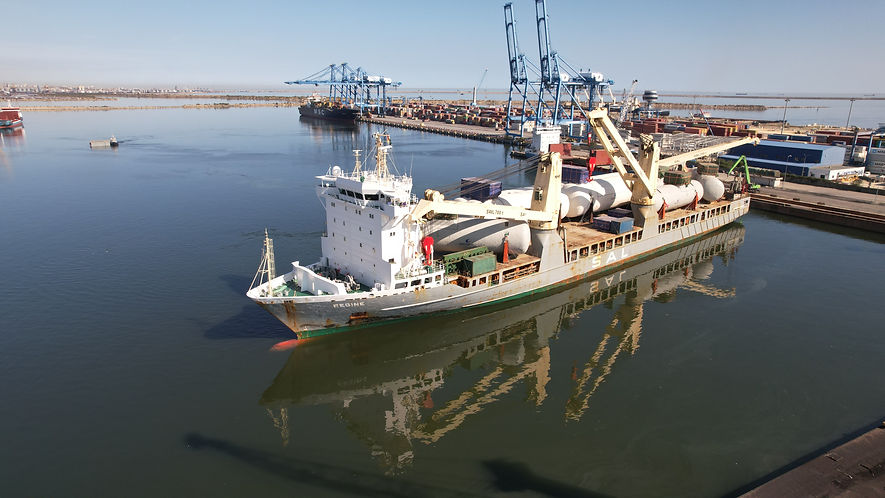
Marine agency
Our port services are supported by dedicated agency services, ensuring coordinated vessel operations from arrival and berthing through cargo handling and departure. Our team manages the necessary port formalities and coordinates with port authorities, terminals, vessel operators and other stakeholders to keep each operation aligned with the project schedule.
Frequently Asked Questions About Oversized Cargo Port Operations
What is oversized cargo handling in port operations?
Oversized cargo handling refers to the loading, unloading, transfer, positioning, and storage of cargo that exceeds standard weight or dimensional limits. These operations require specialised lifting equipment, engineering assessments, and coordinated handling procedures.
What equipment is used to handle oversized cargo in ports?
Depending on cargo specifications and terminal capabilities, oversized cargo may be handled using mobile harbour cranes, ship cranes, heavy-lift cranes, modular trailers, self-propelled modular transporters (SPMTs), specialised rigging equipment, and engineered support structures.
How is heavy-lift cargo unloaded from a vessel?
Heavy-lift cargo is unloaded according to a predefined handling plan that considers cargo weight, centre of gravity, lifting points, crane capacity, and transfer requirements. The cargo is lifted from the vessel, transferred to a designated landing area or transport unit, and moved to its next destination or storage location.
What is the difference between conventional cargo handling and project cargo handling?
Conventional cargo handling generally follows standardised procedures and equipment configurations. Project cargo handling requires individual planning for each shipment, taking into account exceptional dimensions, weight, lifting requirements, transport constraints, and coordination between multiple operational parties.
Can oversized cargo be stored at a port before onward transportation?
Yes. Temporary storage and staging are common components of project cargo logistics. Storage arrangements must account for cargo weight, ground-bearing capacity, support requirements, accessibility, and the planned sequence of onward transportation.
What services are included in port operations for project cargo?
Project cargo port operations may include vessel coordination, cargo loading and unloading, heavy-lift handling, stevedoring coordination, cargo positioning, temporary storage, internal port transportation, documentation, and coordination with subsequent road or inland waterway transport.
Eastship Projects & Logistics coordinates port operations for oversized and heavy-lift cargo, integrating cargo handling, engineering, vessel coordination, storage, and onward transportation. Our approach connects port activities with the wider project logistics chain, supporting the movement of industrial equipment, energy components, and infrastructure cargo.